
Our product rankings are based on analysis of thousands of customer reviews, brand reputation, pricing trends, and popularity data. They represent our honest opinion and are intended as a helpful starting point for your research. Some links on this site are affiliate links — if you buy through them, we may earn a small commission at no extra cost to you. This helps us keep the site free and up to date.
More than most people expect. Every heat pump tumble dryer works the same way: warm air passes through the wet laundry, a cold evaporator pulls the moisture out as water, and the same air is reheated and sent back into the drum. No hot air is thrown away, which is why a heat pump tumble dryer uses roughly half the electricity of a condenser tumble dryer. That heat pump technology is the same in a budget model as in a premium one, so the energy saving is too.
At this price you can expect:
What you give up is mostly extras: steam on most models, a very quiet motor and app control on all but a few. Big names such as Bosch, Samsung and Hotpoint mostly price their heat pump technology higher, with Bosch Series 6 and Samsung models often well over £600, though Hotpoint and Indesit 8kg models do dip into this range in sales. For the things that decide how well your clothes and laundry dry, the gap to a £700 tumble dryer is small.
A budget heat pump tumble dryer makes most sense if you:
If you only dry the odd load in winter, a cheaper tumble dryer will still save money over time, but the payback is slower. Our lowest-priced heat pump dryers are the place to start then.
We picked these from the range above using their real specs from our feed, checked against the makers' listings, and Amazon customer ratings. Stock and prices change daily, so use the cards above for what's available and the price on Amazon today.
The Hisense is the tumble dryer we'd buy for a typical home of two to four people. It has an A++ energy rating with a yearly use of 235kWh, a 64dB noise rating, 16 programmes including an allergy care cycle, and a top-mounted 2.6 litre water container with a drain hose in the box if it sits next to the sink. It is 55cm deep, so it fits most kitchens and under-counter gaps, and it has the most Amazon reviews of anything here, which gives a good guide to how it holds up.

If you wash for four or more, the extra kilo matters more than any feature. A larger drum takes a double duvet or a full load of towels in one go. It has Wi-Fi control through an app, four sensor dry levels, a 24 hour delay start and a Woolmark-approved wool cycle. The 10 year parts guarantee is the longest cover at this price. It is about 60.7cm deep, so measure first.
More options are on our 9kg heat pump tumble dryers page and in the Candy 9kg range.

At 54.5cm deep the Beko is the shallowest dryer in the range, which helps in a narrow galley kitchen or a cupboard with a door that has to close. It has 15 programmes, sensor drying, automatic anti-crease, a child lock and delay start. The warranty is 1 year, the shortest here, so register it with Beko as soon as it arrives.

Heat pump models are slow, so a fast drying programme matters if you often need one shirt or a school uniform dry by morning. The Teknix has a 30 minute quick dry, sensor drying, a reverse action drum, allergy care and a drying rack for trainers and woollens. It weighs 34kg, a lot lighter than most rivals at around 40kg, and comes with 2 years parts and labour. The same machine in titanium is the TKHP8HS, part of our graphite heat pump tumble dryers.
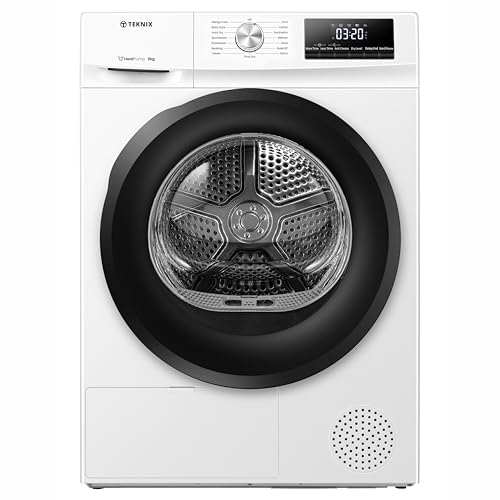
Figures are from our feed and the makers' specs. "Old label" is the familiar A+++ to D scale; a dash means the listing doesn't say.
| Model | Best for | Drum | Old label | Depth | Programmes | Warranty |
|---|---|---|---|---|---|---|
| Hisense DH1Q802BW2 | All-rounder | 8kg | A++ | 55cm | 16 | 2 years |
| Candy Smart Pro CSOEH9A2DE80 | Families, app control | 9kg | A++ | 60.7cm | 14 | 1 year labour, 10 parts |
| Beko BM3T3833W | Small kitchens | 8kg | A++ | 54.5cm | 15 | 1 year |
| Teknix TKHP8HW / TKHP8HS | Quick loads, light | 8kg | A++ | 58cm | - | 2 years |
| Teknix TKHP9HS | 9kg with quick dry | 9kg | A++ | 66cm | - | 2 years |
| Hoover H-Dry 300 HLEH8A1LE-80 | Easy cleaning | 8kg | A+ | 60.7cm | - | 1 year |
| Comfee CFG09EH80/W-UK | Tank or hose | 8kg | A+ | - | 16 | 2 years |
| Candy Smart CSEH8A2LE | Lowest price, Wi-Fi | 8kg | A++ | 60.7cm | 14 | 1 year labour, 10 parts |
| Altimo AHPD912W | 9kg on a budget | 9kg | A++ | 59.6cm | - | 2 years |
Most of the range has an 8kg capacity, which is where the price is lowest and an 8kg heat pump tumble dryer suits most homes. Our 8kg heat pump tumble dryers page has the dearer brands too. A few dryers in the grid, such as the Hoover H-DRY 350 and Teknix TK5HP9HS, often sell for a little over £400, so check the price on Amazon before you buy.
Knowing where the line falls saves you paying for things you don't need, or missing one you do. Above this budget you start to find:
If none of those matter to you, a cheaper model does the same job for less money.
Pick the drum capacity by how much laundry you wash, not by the size of the house. An 8kg drum suits one to four people and takes a single duvet. A 9kg drum is better for a family of four or more, or if you dry bedding and towels every week. Overfilling a smaller tumble dryer makes every cycle longer and cancels out the energy saving. If you need 10kg, look at our 10kg models, which start above this budget.
A++ is the sweet spot here. Moving up a class saves only £10 to £20 a year in electricity, so it rarely pays back the higher price. Our A++ rated models page explains the classes. You will also start to see a new A to G energy label, phasing in during 2026 and replacing the old scale fully in early 2027. The two scales aren't comparable, so a dryer rated A++ may show as a C, D or E on the new energy label without using more energy. The new label also shows a condensation efficiency class and a noise figure, which helps if you want a quiet tumble dryer.
Some of our listings show both, for example the Candy Smart CSEH8A2LE is A++ on the old label and E on the new one, and the Beko BM3T3823W is A++ and C.
Most tumble dryers are 59.5 to 60cm wide and about 85cm high, so the depth is what varies: 54.5cm on the Beko to 66cm on the Teknix 9kg. Leave a few centimetres behind for the plug. Every model collects water in a tank you empty after each load or two; if it will sit by a sink, a drain hose saves that job.
Sensor drying is the one feature to insist on, as it stops the drum when the clothes are dry, avoids over-drying and shrinkage and saves energy on every cycle. After that, look for the programmes you'll actually use: a quick dry, a wool or delicates cycle, bedding and an anti-crease finish.
This is where budget brands differ most. Candy and Hoover give 10 years on parts with 1 year labour, Hisense, Teknix, Comfee and Altimo give 2 years, and Beko gives 1 year (register online for longer cover where offered). Hotpoint and Indesit normally give 1 year too. Your rights under the Consumer Rights Act apply whatever the warranty.
A heat pump dryer uses about 1.5 to 2kWh on an average load, against 3.5 to 4kWh for a condenser dryer. At the Ofgem price cap rate of 26.32p per kWh (1 October to 31 December 2026), the Hisense's 235kWh a year comes to about £62. A B-rated 8kg condenser uses 480 to 562kWh, or £126 to £148 a year. That's a saving of £65 to £85 a year on 160 loads, more if you dry most days, so a £350 heat pump model can pay for its premium over a basic condenser in a few years and then keep saving money.
Three loads a week for five years in the Hisense comes to roughly £300 of electricity at today's rate, against £650 to £770 for a B-rated condenser tumble dryer. That difference alone is close to the price of the dryer.
Condenser and vented models can no longer be sold new in Great Britain from 19 January 2027, after the government raised tumble dryer standards, so for most people a budget heat pump is the only sensible new buy anyway.
The trade-off is time. A heat pump tumble dryer takes longer, often 2 to 3 hours for a full cotton cycle, around 20 to 40 minutes or more beyond a condenser, because it dries the clothes at a lower temperature. That gentler drying is also kinder to clothes, so delicates and wool come out in better shape. To cut the cost and time further:
In October 2025 London Fire Brigade warned about certain older heat pump dryers from Haier, Hoover, Candy, Caple, Baumatic, Iberna, Lamona and Montpellier, which need a safety modification for a fire risk. If you are buying one of those brands second-hand or already own one, check the model on the gov.uk safety notice before you use it. Whatever the brand, don't leave a tumble dryer running overnight or when you go out, and plug it straight into the wall rather than an extension lead.
White is the norm and the cheapest, but a darker finish hides marks in a garage or busy utility room. See our white heat pump tumble dryers and grey models for the full colour choice.
For most homes, the Hisense DH1Q802BW2: energy efficient, 16 programmes, 55cm deep and the best-reviewed model at this price. For a bigger family, the Smart Pro CSOEH9A2DE80.
Only if you need a 10kg drum, an A+++ rating, steam or a longer warranty. The drying itself is much the same. Compare our picks for the best heat pump tumble dryers under £500 if you want those extras.
Generally yes, and two of the brands here back theirs with 10 years on parts. Keeping the filters clean does more for a long life than the brand you choose.
An 8kg A++ model uses about 1.1 to 1.5kWh per load on the label's average, roughly 29p to 39p at 26.32p per kWh. A full cotton load at extra dry can use more.
Yes. The Smart Pro CSOEH9A2DE80, Teknix TKHP9HS and Altimo AHPD912W usually sit in this price band, though prices change.
No. Heat pump models are sealed and collect the water in a tank, so they can go anywhere with a socket and some airflow, including a kitchen or cupboard.


