
Our product rankings are based on analysis of thousands of customer reviews, brand reputation, pricing trends, and popularity data. They represent our honest opinion and are intended as a helpful starting point for your research. Some links on this site are affiliate links — if you buy through them, we may earn a small commission at no extra cost to you. This helps us keep the site free and up to date.
A 10kg drum is the largest size most UK households will need. It is rated by the dry weight of cotton it can take, so a full load is roughly what comes out of a large washing machine after a family wash day. The extra space also lets clothes tumble more freely than in a packed 8kg drum, which helps them dry evenly and come out with fewer creases.
For a busy family household that means fewer cycles each week, less laundry waiting on airers and lower energy use overall.
Heat pump technology is what keeps the energy use and running costs down. Instead of heating fresh air with an element and then cooling or venting it, the dryer reheats the same air in a closed loop. That means a much lower drying temperature, gentler care for fabric fibres and a fraction of the electricity. The lower temperature is kinder to delicate fabric and wool, too. The trade-off is time: a heat pump drying cycle usually takes longer than a condenser dryer on the same load.
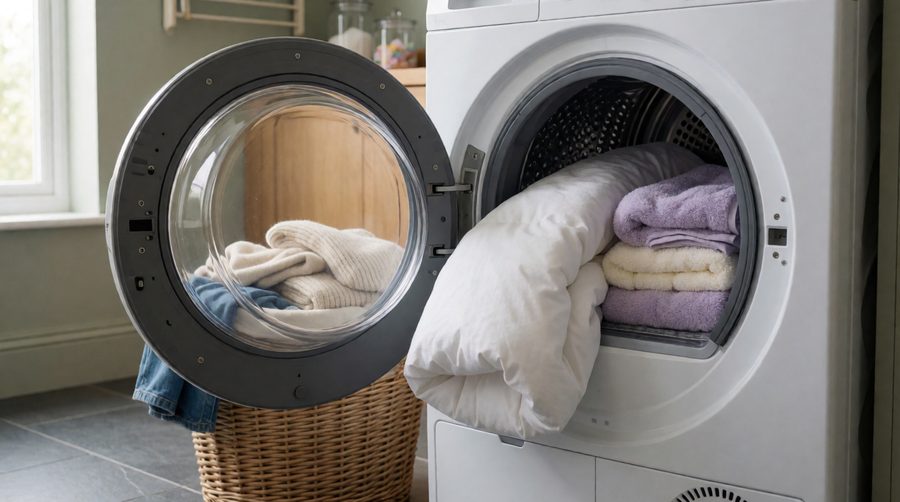
Heat pump technology uses a small refrigeration circuit inside the cabinet, much like a fridge running in reverse. Warm air passes through the wet laundry and picks up moisture from the clothes. It then crosses a cold evaporator, where the water condenses and runs into the water tank or down a drain hose. The now-dry air is warmed again by the condenser side of the heat pump and sent back into the drum. Nothing is vented outside, so you don't need a hose through a wall or window.
| Heat pump | Condenser | Vented | |
|---|---|---|---|
| How it heats | Heat pump, air reused | Element, air cooled and reused | Element, air blown outside |
| Typical full load (9kg) | 2.16 kWh | 5.2 kWh | 5.34 kWh |
| Venting needed | No | No | Yes, hose to outside |
| Drying temperature | Lower, gentler | Higher | Higher |
| Cycle time | Longer | Shorter | Shortest |
| On sale new in GB after 18 Jan 2027 | Yes | No | No |
The kWh figures are the 9kg comparison quoted by Ideal Home and Marks Electrical. A 10kg model will use a little more per full load, but the gap between the three types is similar.
| Drum size | Suits | Good for |
|---|---|---|
| 8kg | Couples and smaller families | Everyday loads, smaller utility spaces |
| 9kg | Families of three to four | Regular washes plus the odd bedding load |
| 10kg | Larger families, sports kit, shared homes | Duvets, towels, bedding and full washer loads in one go |
Match the dryer to your washing machine. If you own a 10kg or larger washer, a tumble dryer of the same size can take a full wash load without splitting it. Bigger isn't automatically better, though: if you mostly dry half loads, a smaller drum with good sensor drying will do the job for less money.
These are the models in our feed, with energy ratings and sizes from the product listings. Stock changes often, so check the cards above for what is available today.
| Model | Old label | New label | Depth | Weight | Stand-out feature |
|---|---|---|---|---|---|
| Haier X Series 7 HD100-C367GU1 | A+++ | C | 61cm | 56kg | UV Ion Air Fresh, 5 year warranty |
| Haier X Series 9 HD100-CQ387U1 | A+++ | C | 61cm | 60kg | Pillow drum, I-Refresh |
| Hisense 7S Series DH7S107BB | A+++ | - | 64cm | 58kg | Self-cleaning condenser, steam |
| Cater-Wash CK8510 | A+++ | D | - | - | 66dB, night dry cycle |
| Candy Quick Pro GD 10N1-80 | A++ | E | 60cm | 42kg | Quick cycles from 14 minutes |
| Hoover H-Dry 500 NDEH10A2TCBER | A++ | - | 60.4cm | 41.4kg | hOn app, AquaVision door tank |
| Hoover NDH10A2TCBER | A++ | E | - | 43.2kg | Auto sensing, quiet operation |
The pattern is clear: the A+++ machines are heavier and often deeper, because a bigger heat pump and better insulation add bulk, and they often come with longer warranty cover on parts. The A++ Candy and Hoover models are lighter and usually cheaper. Several of these are dark finishes; browse our graphite models, grey models or white models if colour matters.

From 1 October to 31 December 2026 the Ofgem price cap puts electricity at 26.32p per kWh for Direct Debit customers. Using the 9kg figures above:
For a large family running the dryer four or five times a week, the saving grows to well over £150 a year. The government's own figures in its tumble dryer standards consultation put the net saving at around £250 over a condenser model's 12-year life, and about £900 over a heat pump's expected 20 years. The energy saving is the main reason to choose heat pump technology over a condenser dryer. For the lowest bills, pick an A++ rated model or better and use the eco cotton programme.
You'll often see two energy ratings on the same machine, as in our table. The old label runs from A+++ to D, and almost every heat pump model scores A++ or A+++. The new label uses a stricter A to G scale, so the same dryer drops several letters: the X Series 7 is A+++ on the old scale and C on the new one, while the Quick Pro is A++ and E. The dryer hasn't got worse; the test and the scale changed. Compare like with like on energy efficiency, and look at the kWh per cycle and the annual energy consumption where they are given. The new label also shows the condensation efficiency class, which tells you how much moisture stays in the tank rather than the room.
Moisture sensors stop the drying programme when the laundry reaches the dryness you chose, such as iron dry or cupboard dry. On a big drum this matters more, because timed drying a 10kg load is guesswork, and over-drying wastes energy and wears fabric. Ultra Sense 3D on the X Series and AI Dry on the Hisense 7S are both sensor drying systems.
Cotton eco, mixed, synthetics, wool, bedding and a quick refresh programme cover most homes. A duvet programme is worth having on a big drum because that is what the size is for. An allergy or hygiene drying programme helps if anyone in the family has sensitive skin, and a steam refresh programme relaxes creases in clothes that have sat in a wardrobe. Five quick cycles on the Quick Pro suit anyone who needs one outfit ready fast.

A full 10kg load gives off several litres of water, so the tank fills quickly. If your dryer sits near a sink or washing machine waste, connect the drain hose and never empty it again. The Hoover H-Dry 500 has its AquaVision tank in the door, which is handy if you will empty it by hand.
Every heat pump tumble dryer has a lint filter in the door, and most have a second filter in front of the heat exchanger. Blocked filters are the main reason drying times and energy consumption creep up. A self-cleaning condenser, as on the Hisense 7S, rinses the heat exchanger for you, so that filter needs cleaning by hand far less often.

Smart apps such as hOn and Hisense's ConnectLife tell you when a cycle finishes, add extra programmes and can start the dryer remotely. Useful, but not essential.
Heat pump tumble dryers run a compressor, so they hum a little. Where a figure is given it is usually mid-60s dB; the Cater-Wash CK8510 quotes 66dB. Warranty cover varies from 1 year to 5 years on the X Series, and some brands add a 10 year parts warranty.

Most models at this size are 60cm wide, and the height is about 85cm, so they slide under a standard worktop. Depth is the figure to check: 60cm to 64cm in our range, plus room for the door to open and the plug and hose behind. They are heavy too, from 41.4kg up to 60kg, so a two-person lift is needed.
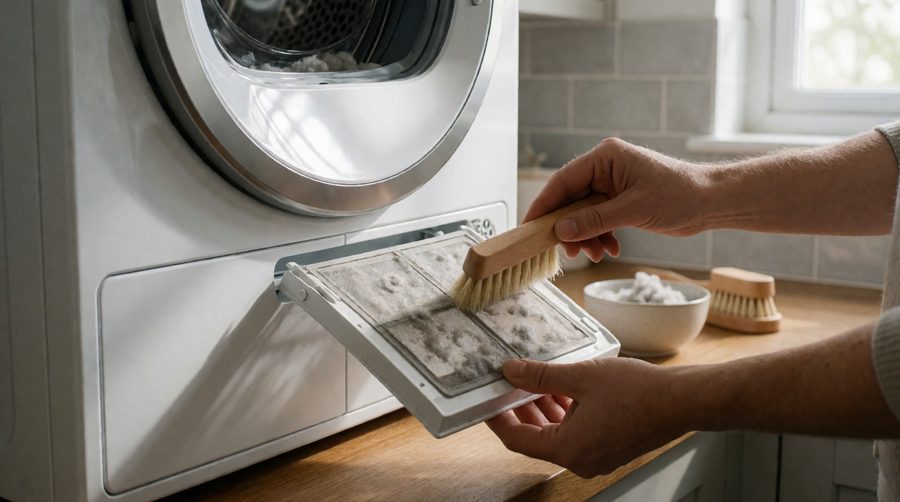
Clean the door filter after every drying cycle and the heat exchanger filter every few weeks. That keeps drying times short and is the first piece of fire safety advice from the London Fire Brigade. Don't run a tumble dryer overnight or while you are out, and plug it straight into a wall socket rather than an extension lead.
If you own an older heat pump tumble dryer made by Haier, including some Hoover and Candy models, check whether it is part of the Haier heat pump dryer safety repair. The government says affected machines must not be used until they have been modified. Registering a new appliance with the maker means you will be told about any recall, and it often activates the parts warranty too.
The Household Tumble Dryers Regulations 2026 set minimum energy efficiency standards that only heat pump technology can meet. From 19 January 2027, new vented, condenser and gas tumble dryers can no longer be placed on the Great Britain market, and the A to G label becomes mandatory. Machines you already own aren't affected. Makers must also keep key spare parts available for longer, which suits a machine expected to last up to 20 years.
A full cotton load on the eco programme takes noticeably longer than in a condenser dryer, because the air is cooler; the product information sheet lists the exact programme time. Smaller loads and quick programmes are much faster: the Quick Pro has cycles from 14 to 59 minutes.
It will work, and sensor drying stops half loads from over-drying, but you are paying for space you won't use. A 9kg dryer or a model from our budget heat pump range is often the better buy.
Usually yes, with the right stacking kit, as long as the washer is a front loader of the same width. Check the weight: some of these dryers weigh close to 60kg.
No. Water collects in a tank or drains away through a hose, so you can fit one in any room with a socket and a suitable temperature.
Prices change daily. Lighter A++ machines are usually the cheapest; see our picks under £400 and under £500, or the Candy range for good-value options.
For energy use, yes, by a wide margin. A condenser dryer is quicker per cycle, but from 19 January 2027 new ones can't be sold in Great Britain anyway, so heat pump models are what manufacturers will be building from now on.
